
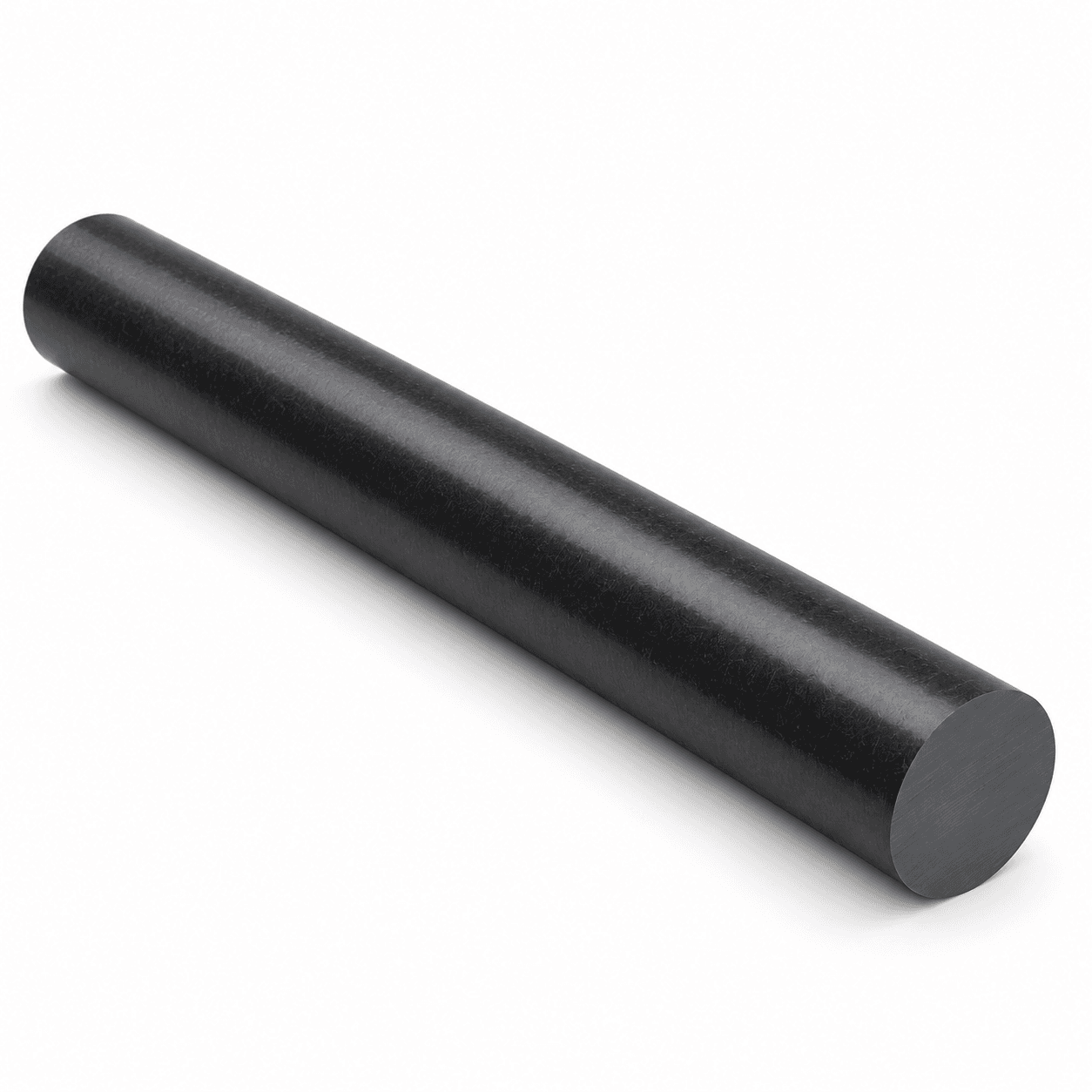
Shop PEEK CF30 by shape
Select a form factor to view real-time inventory, pricing, and custom cut-to-size options.
Filters
Color
Shape
Availability
Thickness (sheet) / Diameter (rod)
Rods
2 sizes · 2 SKUs| Short Description | Color | Diameter | Length | Stock | Price | Action |
|---|---|---|---|---|---|---|
| PEEK CF30 - 0.630" dia x 118 Black Rod | Blk. | 0.630″ | 118″ | 0Out of stock | $686.88 | |
| PEEK CF30 - 0.630" dia x 48 Black Rod | Blk. | 0.630″ | 48″ | 0Out of stock | $279.41 |
Material Overview
What is PEEK?
PEEK CF30 is a 30% carbon-fiber-reinforced grade of PEEK — polyetheretherketone — engineered for applications that demand the highest stiffness, strength, and dimensional stability within the PEEK family. The carbon fiber reinforcement dramatically increases rigidity and load-bearing capacity compared to unfilled PEEK, while simultaneously reducing thermal expansion and improving tribological performance under sliding contact.
PEEK CF30 achieves a tensile strength of 35,000 psi (242 MPa) and a tensile modulus of 3,538,000 psi (24,400 MPa) — roughly six times stiffer than unfilled PEEK in modulus. Long-term service temperature reaches 500°F (260°C), with short-term capability to 570°F (300°C). Density is 1.39 g/cm³, and the carbon fiber reinforcement imparts inherent lubricity, making CF30 a natural fit for structural wear components that also require dimensional precision at elevated temperatures.
Grades comparison. Choose PEEK CF30 when stiffness and dimensional stability under load are the primary drivers. If you need reinforcement with retained electrical insulation, step down to PEEK GF30 — 30% glass-fiber reinforced, which carries a volume resistivity of 10¹⁴ Ω·cm versus CF30's conductive 10⁴ Ω·cm. For applications combining maximum wear resistance with lubrication, consider PEEK PVX — triple-blend wear grade or PEEK PTFE — bearing grade. When electrostatic dissipation in a cleanroom environment is required, see PEEK ELS.
Typical applications. PEEK CF30 is specified for structural brackets, housings, pump components, valve seats, aerospace structural parts, and high-load bearing surfaces where metallic components are being replaced to reduce weight. The material machines on standard CNC equipment using sharp carbide tooling; because of the abrasive carbon fiber content, tungsten carbide or PCD tooling is preferred for extended tool life. Contact Ready Plastics for available sheet and rod stock sizes.
Technical Specifications
PEEK properties
Typical values at 23°C / 50% RH. Values are nominal and not guaranteed; refer to lot-specific certificates of conformance for production parts.
Frequently Asked Questions
PEEK, answered
What is PEEK CF30?
PEEK CF30 is a grade of PEEK (polyetheretherketone) reinforced with 30% carbon fiber by weight. The reinforcement increases tensile strength to 35,000 psi and tensile modulus to 3,538,000 psi — making it the stiffest and strongest standard grade in the PEEK family — while also reducing thermal expansion and adding inherent lubricity for wear applications.
What is the difference between PEEK CF30 and PEEK GF30?
Both grades add 30% fiber reinforcement to PEEK, but the fiber type drives different property profiles. PEEK CF30 (carbon fiber) achieves higher stiffness — tensile modulus of 3,538,000 psi — and inherent electrical conductivity (volume resistivity ~10⁴ Ω·cm), making it unsuitable where electrical insulation is required. PEEK GF30 (glass fiber) offers a lower modulus of 1,609,000 psi but retains dielectric insulation (volume resistivity ~10¹⁴ Ω·cm) and delivers better impact toughness (64 kJ/m² Charpy vs. 44 kJ/m² for CF30). Choose CF30 for maximum stiffness and wear; choose GF30 when insulation is required.
What shapes does Ready Plastics stock in PEEK CF30?
Ready Plastics stocks PEEK CF30 in rod and sheet forms. Specific diameters and sheet thicknesses are listed on the product datasheet — contact Ready Plastics for current stock availability and cut-to-length options.
Can PEEK CF30 be machined?
Yes, but the carbon fiber content is abrasive. Tungsten carbide or PCD (polycrystalline diamond) tooling is strongly recommended for extended tool life. Use sharp edges, moderate cutting speeds, and air blast or light coolant to manage heat. Avoid conventional high-speed steel tooling, which dulls quickly on filled PEEK grades.
Is PEEK CF30 electrically conductive?
PEEK CF30 has a volume resistivity of approximately 10⁴ Ω·cm and surface resistivity of approximately 10⁵ Ω — it is electrically conductive, not insulating. This is a direct result of the carbon fiber reinforcement. If your application requires electrical insulation, select unfilled PEEK (>10¹⁴ Ω·cm) or PEEK GF30 instead.
Ready to spec material for your build?
Get a quote on cut-to-size sheets and rods, request a full data sheet, or talk to a plastics engineer. We answer in under two hours, M–F 8am–6pm ET.